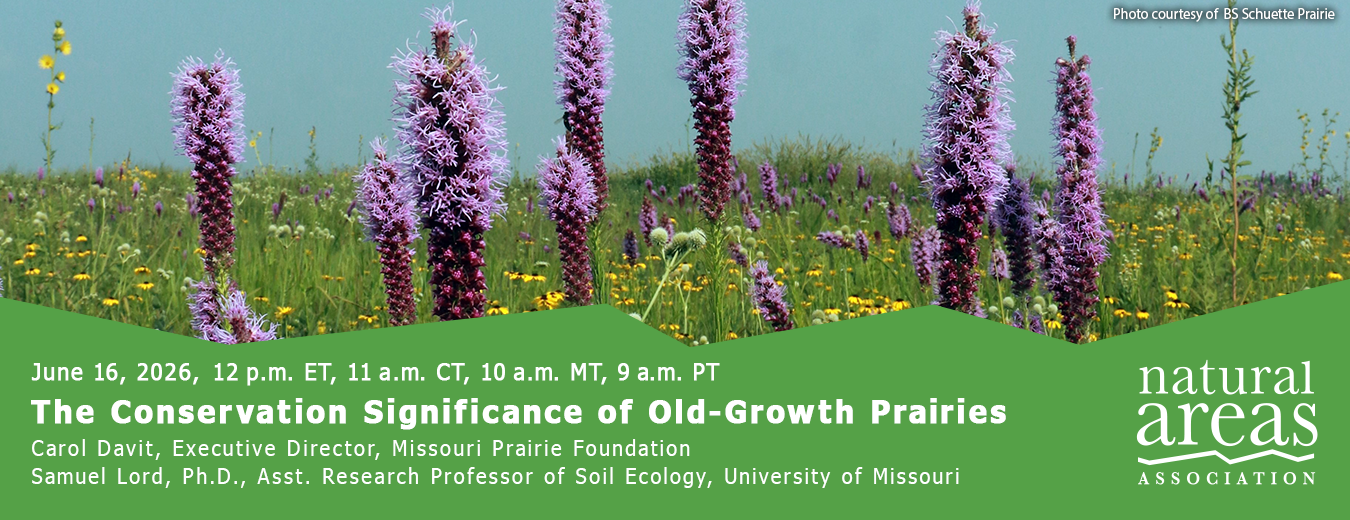
While most of the Midwest's once vast tallgrass prairie landscapes have disappeared through land conversion, intact remnants of ancient prairies still exist, providing vital habitat for prairie-dependent life forms, seed sources for the native seed industry, and an extremely complex soil microbiome. Join Dr. Sam Lord, soil scientist with the University of Missouri, and Carol Davit, executive director of the Missouri Prairie Foundation, to learn about some of the most biologically diverse old-growth natural communities in North America.
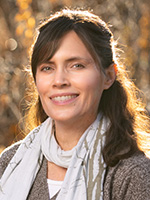
Carol Davit, Executive Director, Missouri Prairie Foundation
Carol Davit is the executive director of the 60-year-old Missouri Prairie Foundation and Grow Native!, its 26-year-old native plant marketing and education program. She has worked for 27 years in conservation and environmental communications, development, administration, and leadership for private and nonprofit conservation groups, as well as municipal and state governments. She is also the chair of the Missouri Invasive Plant Council.
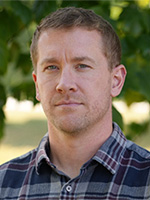
Samuel Lord, Ph.D., Asst. Research Professor of Soil Ecology University of Missouri, School of Natural Resources, Center for Agroforestry
Sam Lord is a soil ecologist and Assistant Research Professor at the University of Missouri Center for Agroforestry. His work explores how soils, plants, and microbial communities interact to shape the health and resilience of ecosystems. He studies both native prairies and working agricultural lands to understand how natural systems maintain efficiency and stability, and how those lessons can be applied to support more sustainable land management. By combining soil measurements with modern tools for studying microbial communities, his research aims to reveal the hidden biological processes that drive ecosystem function from the ground up.

Support the people who manage our natural areas and protect biodiversity in perpetuity.